My Story

Matt Walsh
Matt Walsh is a national touring entertainer, producer, and creative director who specializes in live entertainment and studio production. A cartoonist and animator before he was ever widely known as a performer, he entered live entertainment unexpectedly as a teenager and went on to build a national career across major U.S. markets. Over time, his work expanded outside the stage into recording, production, direction, editing, and business development, culminating in the launch of The Matt Walsh Company as an independent creative and production house. Today, he is best known for combining the instincts of a visual artist, the discipline of a stage performer, and the standards of a producer into one polished live experience.

The Cartoonist
Matt’s early artistic identity centered on cartooning and animation. By age eight, he aspired to own his own animation studio, inspired by shows like Danny Phantom and SpongeBob SquarePants, as well as broader influences from Nickelodeon, Cartoon Network, Pixar, and Looney Tunes. Immersed in animated media, he became recognized among classmates for his unusually accurate drawings. By attentively observing existing characters and practicing through repetition, he quickly learned to break down forms, build structural accuracy, and polish his technique. Soon, his drawings were nearly indistinguishable from those on screen.
Influenced by figures such as Chuck Jones, Walt Disney, Brad Bird, John Lasseter, Steve Jobs, Rob Renzetti, Craig McCracken, and Butch Hartman, Matt became fully committed to the idea of one day building his own studio—a dream that would later take shape under the name Matt Pics Animation. A key moment came when a jealous classmate remarked that Matt only copied existing cartoons and did not create any original characters. In response, he doubled down and began designing original cartoon characters, a shift that helped solidify his desire to one day build an animation studio under his own name. As his creativity blossomed and his original work became more ambitious, he began receiving local recognition for his artistic ability, winning awards in video and creative work, participating in district and state competitions, and even meeting and drawing alongside former Disney animators, including artists connected to The Lion King, The Little Mermaid, and Lilo & Stitch. With his interests now expanding beyond drawing alone, Matt explored 2D animation and, later, early CGI. Lacking formal tools, he animated on printer paper, assembling short sequences and fragments by hand. By thirteen, he had launched his own website and was uploading cartoons, short animatics, and whatever fragments of animation he could produce and preserve. Part of that self-publishing instinct was shaped by the same youth-internet culture surrounding him at the time, including iCarly, which helped normalize the idea that young makers could build and share their own work online. At the same time, the path was constrained by practical realities: animation was expensive, the tools were not easily accessible, software and computers were costly, and the infrastructure needed to seriously develop that dream was largely out of reach. Even so, the visual instincts formed during that chapter—movement, structure, timing, design, and presentation—remained foundational and would later carry into every other part of his creative life.

The Early Performer
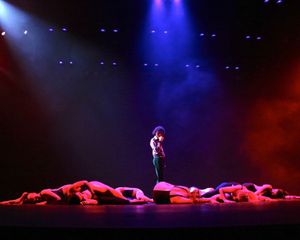
From as early as age four, Matt was placed in performance settings, rarely showing any visible hesitation in front of an audience. His preschool appearance in Rudolph the Red-Nosed Reindeer stands out among his earliest memories. By age six, youth-oriented television like The Naked Brothers Band strengthened his sense that artistically inclined children were simply supposed to sing, write songs, perform, and create; he soon wrote his first song in that spirit. At seven, during a school Christmas event in which his class was scheduled to sing “Feliz Navidad,” he found himself shushing other children backstage because he already understood that the audience could hear every murmur. For Matt, the experience of being onstage felt functionally identical to being offstage; he had little instinctive understanding of why other children became nervous in front of an audience.
When Matt turned eight, the range of those appearances began to widen. He joined other students in singing Christmas carols for elderly residents at a local nursing home, and at his after-school program, he participated in “Worship Wednesdays”, where other children led simple choreography and vocal parts to songs such as Mary Mary’s “Shackles” and Kirk Franklin’s “Stomp”. Those sessions gave him an early introduction to singing and dancing simultaneously, as well as to Black gospel traditions. The program alternated those Wednesdays with talent shows, and Matt became a regular participant. Performing loosely comic dance routines inspired in part by Madagascar, he won so consistently that organizers eventually stopped counting him as a formal competitor and simply let him perform while rotating the remaining children through the placements. By age ten, the settings had become more formal. In fifth grade, he participated in All-County Choir, where he was introduced to harmony and to singing with a live band for the first time. Later that year, when his school folded the choir into a larger theatre production, he was entrusted with six acting roles, including lead and emcee-style parts, supporting roles, and choir. He was given a headset microphone and later recognized for his efforts in coordinating other students backstage. Over the same period, he watched other children freeze, lose confidence, forget lines, or drift off pitch under attention; none of that ever seemed to happen to him.
Between the ages of twelve and thirteen, Matt’s performances receded, while his cartoons and animation ambitions were front and center. During the same period, his musical ear was widening. Soft rock and classic rock became part of his daily listening, and by thirteen, newer discoveries such as Daft Punk’s “Get Lucky” and Pharrell Williams’ “Happy” were beginning to pull him towards classic soul, rhythm and blues, and later, disco.
THE Unexpected Path